
Huawei has launched its FusionSolar9.0 Smart PV & ESS solution in Malaysia, marking a shift from conventional solar systems to intelligent, grid-stabilising and artificial intelligence (AI)-driven energy infrastructure.
According to Huawei, the latest solution is aimed at supporting Malaysia’s transition towards more intelligent, resilient and sustainable energy systems.
Unlike traditional solar setups that primarily focus on electricity generation during the day, FusionSolar9.0 integrates solar generation, energy storage and AI-based optimisation into a single system that can manage how energy is produced, stored and used more efficiently.
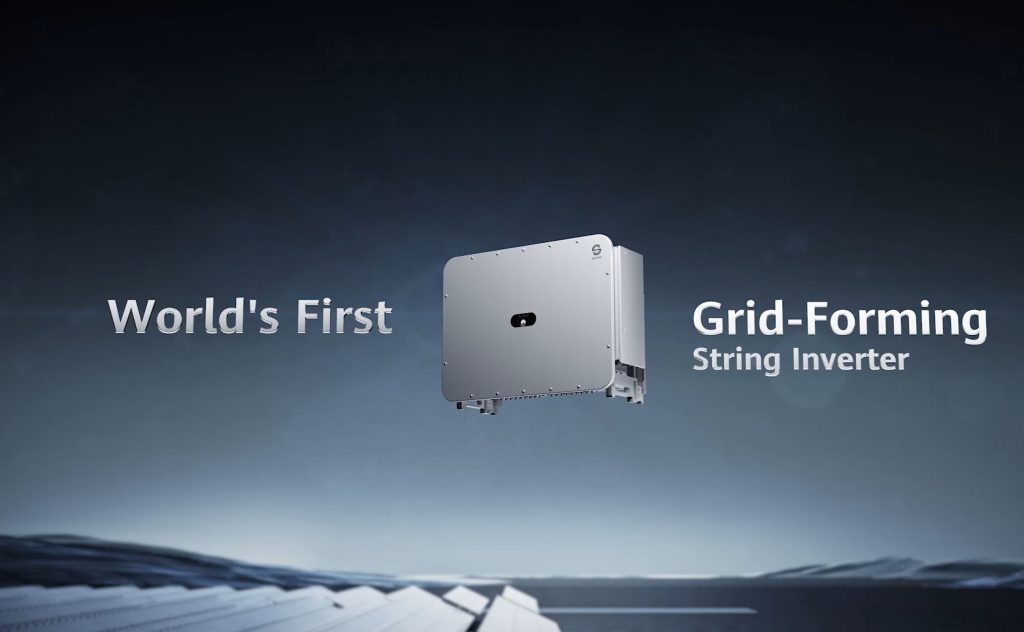
Huawei’s FusionSolar9.0 boasts several industry firsts including the world’s first grid-forming string inverter and the first 1000-volt alternating current (Vac) PV system. The platform is also capable of supporting up to 11 megawatts (MW) of PV capacity through what it describes as a fundamental technological breakthrough.
In addition, Huawei says AI enables autonomous operations with minimal or no on-site personnel, making it suitable for deployment across mountainous, floating and remote island sites, while equipping each plant with self-optimisation capabilities.
Huawei Malaysia Executive Vice President of Digital Power Business Chong Chern Peng said, “Our ambition is clear: 70% by 2050. Achieving this will require speed, scale, and smarter technologies. This is exactly where the Huawei FusionSolar9.0 comes in.”
He added that by intelligently managing and storing solar energy, dependence on volatile fossil fuels can be reduced while lowering emissions, stabilising costs and building a stronger energy future.
At the core of the system are Huawei’s SUN2000-506KTL-H3 Smart String Inverter and the LUNA2000-241 energy storage system (ESS), which are designed for utility-scale and large commercial and industrial (C&I) deployments.
SUN2000-506KTL Smart String Inverter
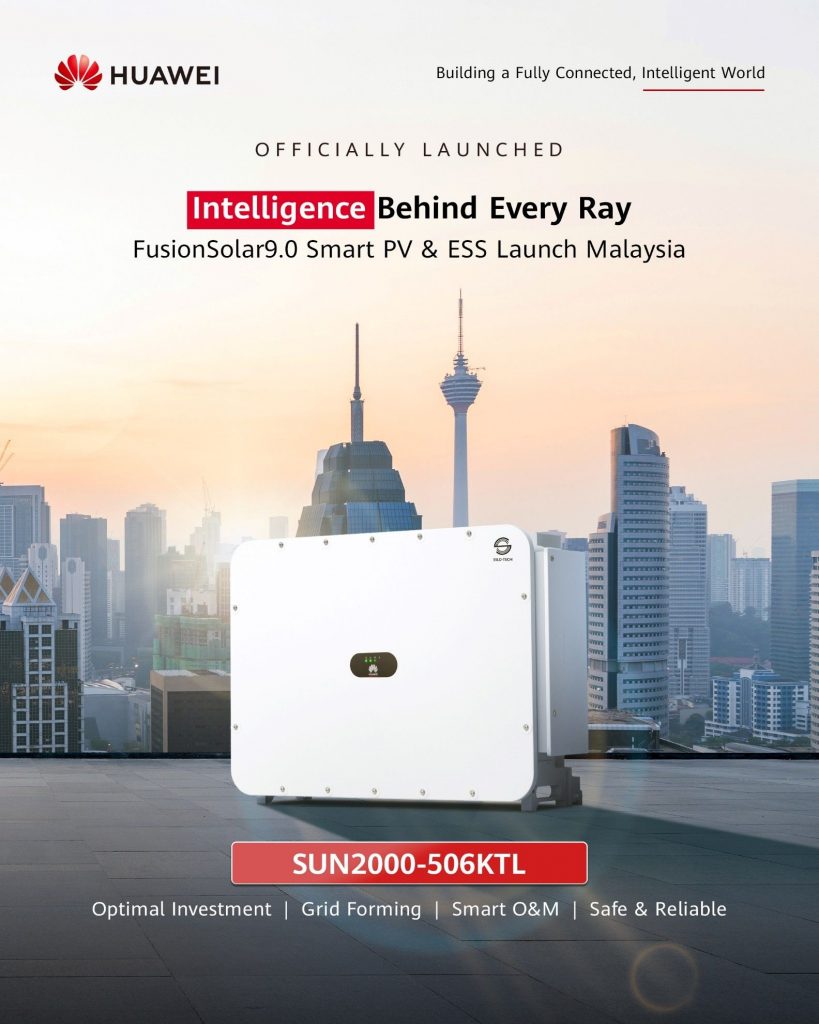
The SUN2000-506KTL-H3 is a 506kW class inverter designed for large-scale solar installations. Its primary role is to convert electricity generated by solar panels into usable power for the grid or on-site consumption.
As part of the FusionSolar9.0 system, the inverter supports what Huawei describes as grid-forming capability, where it can help stabilise the grid.
LUNA2000-241 energy storage system (ESS)
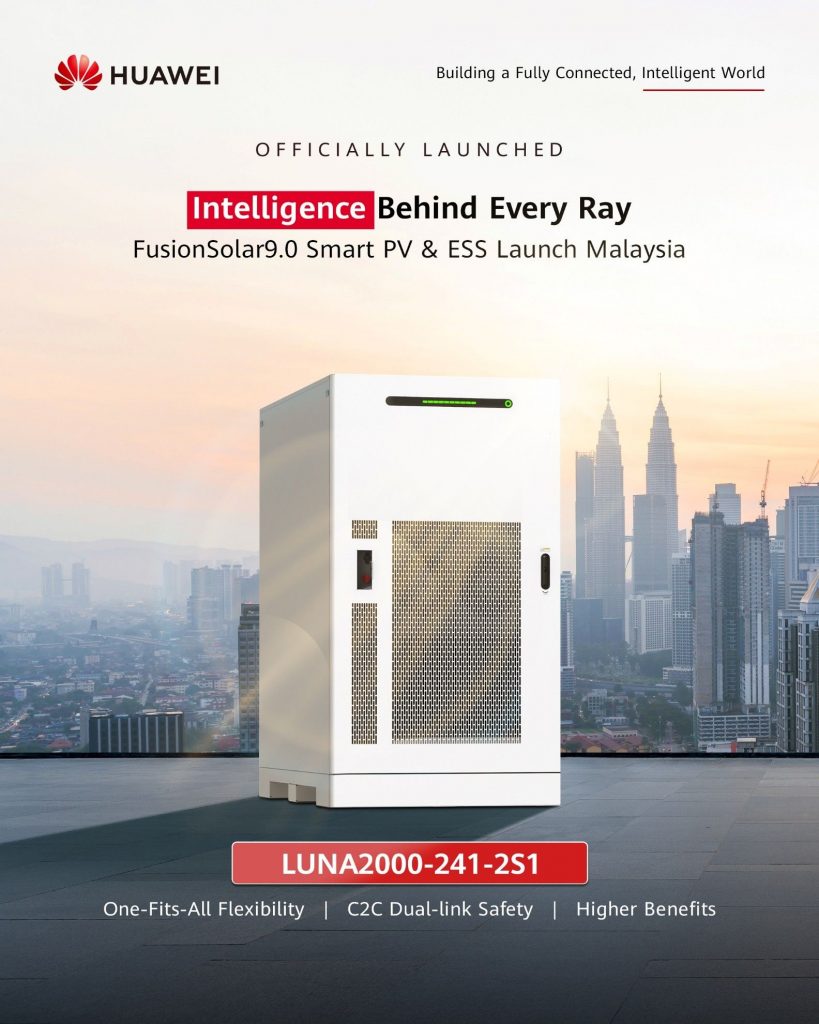
Huawei has also introduced the LUNA2000-241 ESS, which is used to store excess solar energy. It uses LFP battery cells with a total rated capacity of 241kWh.
Huawei says the system uses AI-enabled scheduling to optimise energy storage and dispatch, delivering up to 20% higher energy yields and achieving a round-trip efficiency of 91.3%.
The ESS also supports both on-grid and off-grid operation to help reduce downtime and operational risks. Huawei added that its safety features have been tested against international fire safety standards to ensure reliable performance in demanding environments across a wide range of industries. It also says the ESS contributes to lower levelised cost of energy (LCOE) and stronger long-term returns for businesses and energy investors.
Huawei’s solution to deliver cost savings of up to USD300,000
Huawei adds that in line with Malaysia’s National Energy Transition Roadmap (NETR), the solar and renewable energy sector is expected to contribute an additional RM220 billion to the Gross Domestic Product (GDP) and create up to 310,000 green growth job opportunities by 2050.
Huawei says its FusionSolar9.0 PV & ESS solution improves overall performance and lowers long-term operating costs. It claims to increase energy output by approximately 1%, improve system fault detection by more than 50%, and enable smarter, data-driven maintenance that reduces manual checks.
Over a 25-year lifecycle, Huawei says the solution can deliver operating cost savings of up to USD300,000 (about RM1.191 million), while improving plant reliability and enabling more predictable returns.
0 comments :
Post a Comment